An ocean that carried the continent
The ocean surface can look remote from a city. The air above it can still carry a continental history.
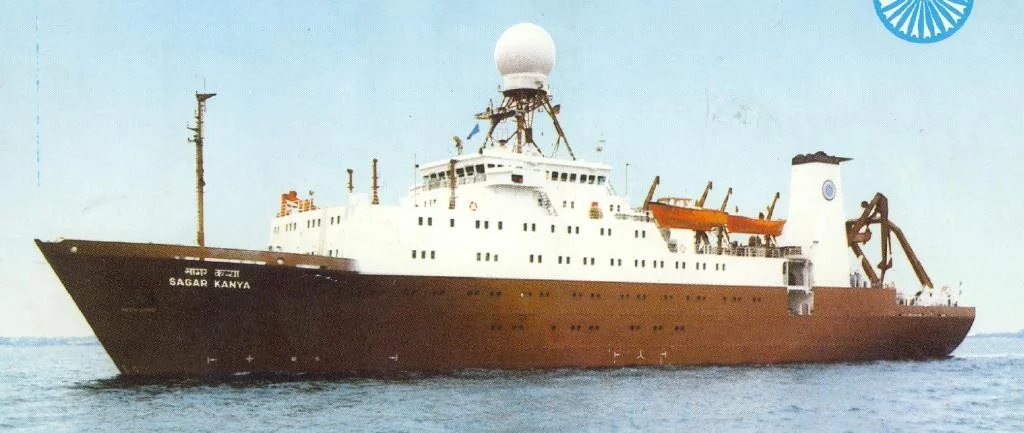
During the Indian Ocean Experiment, ships, aircraft, satellites and ground stations investigated how aerosols crossed the region and altered radiation. Sagar Kanya supplied a moving laboratory: a way to sample changing air masses along a long ocean route rather than watch them from one fixed site.
The campaign chronology matters. A pre-INDOEX cruise ran from 5 January to 4 February 1996 and was reported in a 1998 paper led by A. Jayaraman. The later intensive phase included a Sagar Kanya cruise from 20 January to 12 March 1999. Jayaraman, Satheesh, Mitra and Ramanathan reported its latitude-dependent aerosol properties in Current Science in 2001. These are related investigations, separated by years. The 1996 study ↗ The 1999 cruise study ↗
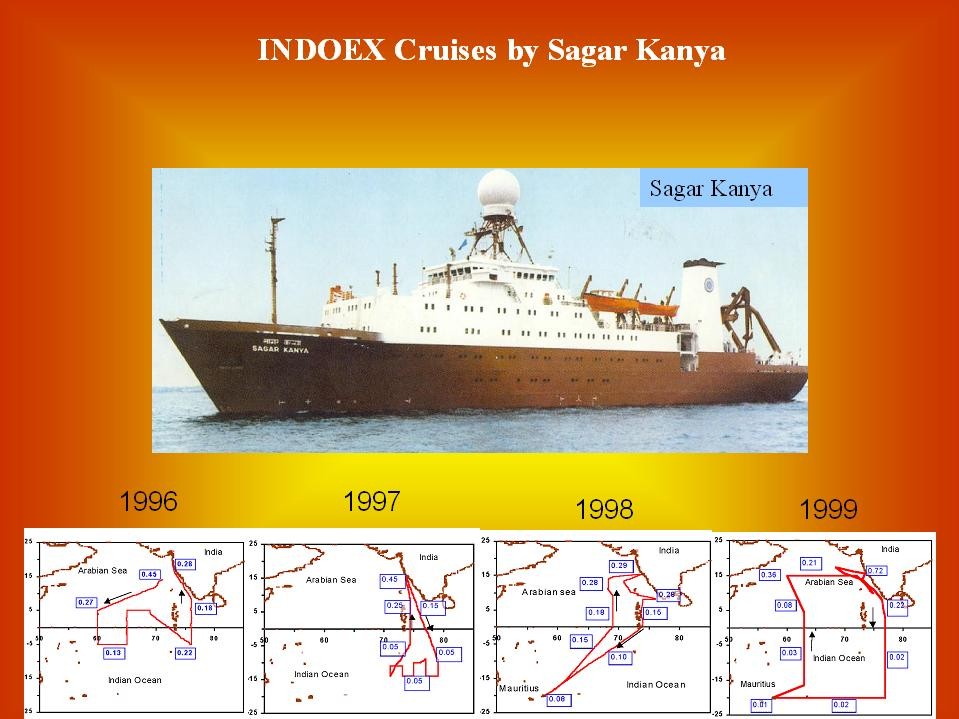
The scientific question was not simply whether pollution existed offshore. It was how aerosol properties changed across contrasting air masses, including across the Inter Tropical Convergence Zone, and what those differences meant for radiation. A moving ship could connect a geographic gradient to several properties of the particles.
Sun photometry measured optical depth through the atmospheric column above the ship. Other instruments measured near-surface particle mass and size, scattering and absorption. These measurements were complementary. Deck-level air could differ from an elevated layer affecting the Sun’s beam, and particle water uptake could change scattering without a proportional change in dry mass.
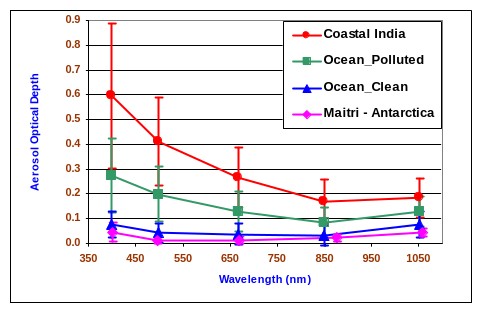
The observations revealed a strong north–south contrast in aerosol properties across the sampled convergence region. Continental influence extended over the northern ocean, while the more southerly air masses differed. This was a meteorological and chemical transition, rather than a fixed latitude separating two permanent atmospheres.
Shipboard work introduced its own source problem: the ship. Measurements needed attention to wind direction and possible exhaust contamination. Instruments with different sampling and angular responses also required separate interpretation. A convincing gradient could not be established merely by plotting every reading in route order.
Radiation measurements and calculations connected aerosol properties to changes in sunlight. An absorbing component could reduce solar energy at the surface while adding energy within the atmosphere. The result helped make the Indian Ocean a setting for studying continental aerosol influence, rather than assuming a marine atmosphere was controlled only by sea spray.
How to read a cruise comparison
Check the sampling date as well as the latitude. A ship moves through weather that also evolves. Inspect exhaust screening, humidity treatment, spectral bands, instrument calibration and the relation between the near-surface and column samples. An apparent spatial pattern can include temporal variability.
The lasting contribution is methodological as well as geographical: a distant ocean can be understood by measuring several properties together and tracing the air’s changing context.
What kind of particle population crossed the sea?
The size distribution asks a more specific question than total loading. The comparison from the personal archive below sets an Arabian Sea size distribution against a maritime aerosol model and shows several fitted modes.
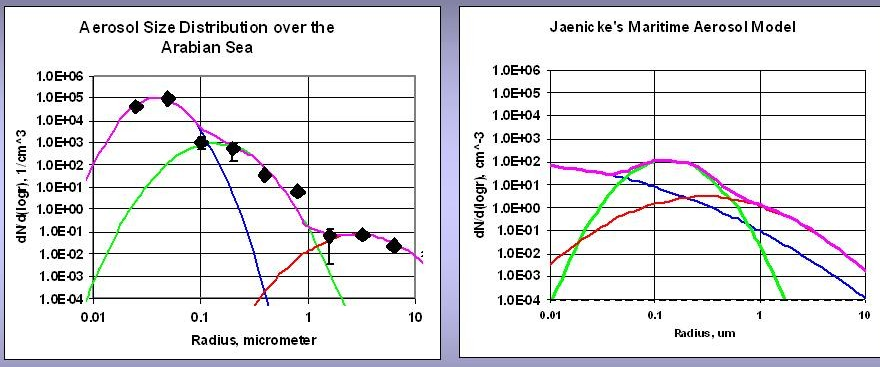
The enhanced fine-particle part of the plotted distribution illustrates the contrast with the maritime model.
Ramanathan and colleagues’ integrated INDOEX analysis combined measurements from several platforms with models to connect aerosol composition and optical properties to radiative forcing and regional climate effects. The paper documented a mixture of inorganic and carbonaceous particles, including absorbing black carbon, rather than an atmosphere controlled only by sea spray. The integrated INDOEX analysis (2001) ↗