A research career can be read as a sequence of questions. The instruments reveal how those questions became answerable.
Professor A. Jayaraman’s work connects optical instrument development, upper-air observations and collaborative field campaigns. At PRL and later at NARL, where he served as director, those questions developed through the work of researchers, engineers and observing teams.
The research record spans upper-air photometry, volcanic aerosol observations, ocean and land campaigns, airborne lidar, absorbing aerosols and tropical clouds. Its continuity lies less in a single instrument than in an approach: identify what is missing from the observation, then develop or combine methods to constrain it.
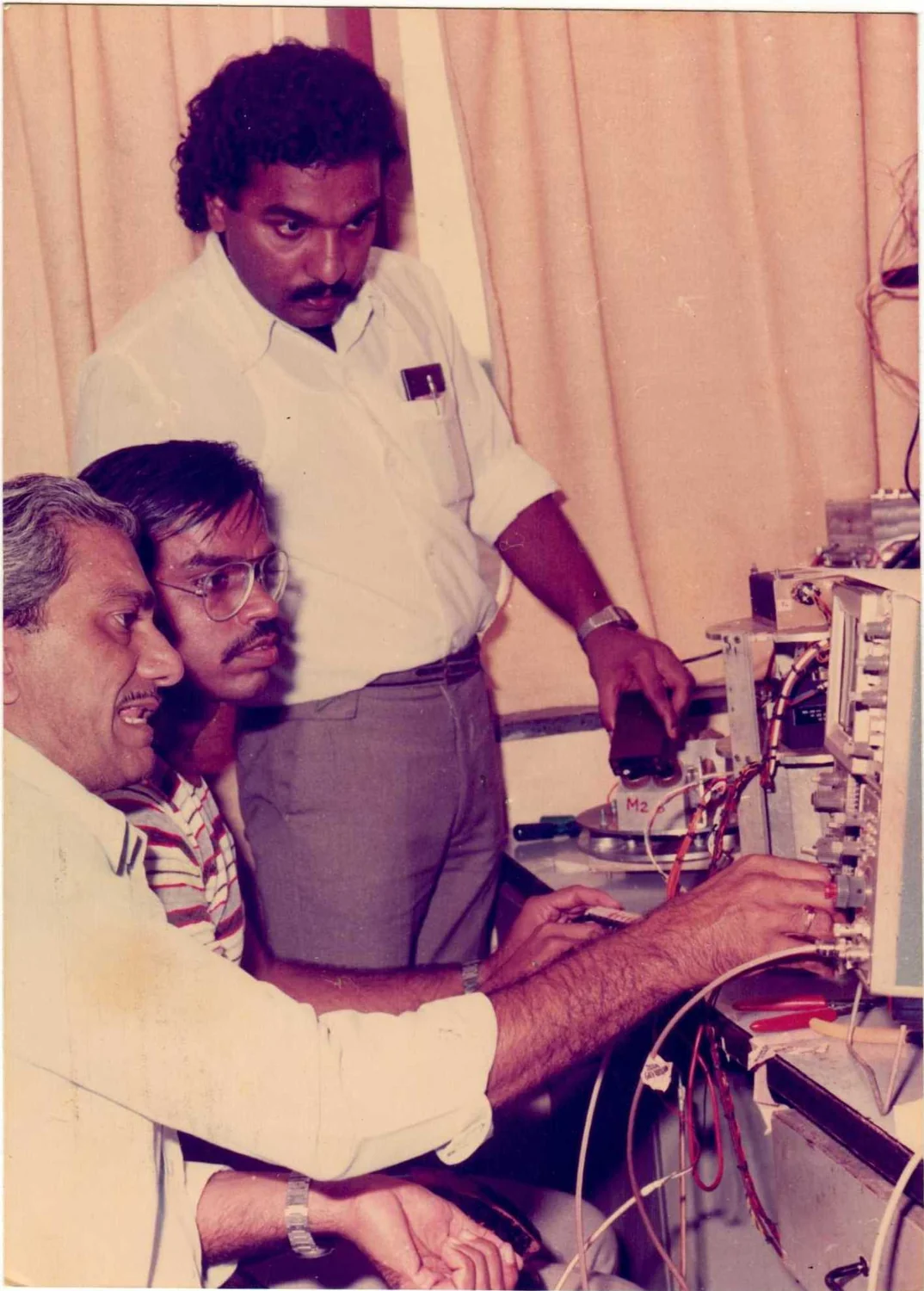
The work before a launchMembers of the PRL team testing a rocket payload. The photograph preserves the hands-on work of instrument development before a measurement could begin.A. Jayaraman’s personal archive.View image ↗
At the Physical Research Laboratory in Ahmedabad, photometric work connected instrument development with measurements of atmospheric constituents. Studies of ozone belonged to this wider optical lineage, although ozone is a gas and should not be confused with aerosol.
The balloon-photometry programme provided a capability that could respond to Pinatubo. Its instruments combined tracking, scanning, spectral filters and supporting meteorology. The useful scientific product depended on the whole chain, from pointing and calibration to the scattering calculation.
The 1994 balloon paper was led by S. Ramachandran with A. Jayaraman, Y. B. Acharya and B. H. Subbaraya. The 1995 Ahmedabad lidar paper was led by A. Jayaraman with the same collaborators. Their different observations became complementary parts of the volcanic-layer story. Read the study ↗Read the study ↗
Acharya and colleagues’ LED sun photometer supplies another example of the link between electronics and atmospheric physics. The detector was only one component: spectral response, logarithmic readout and calibration made it into an optical-depth instrument. Read the study ↗
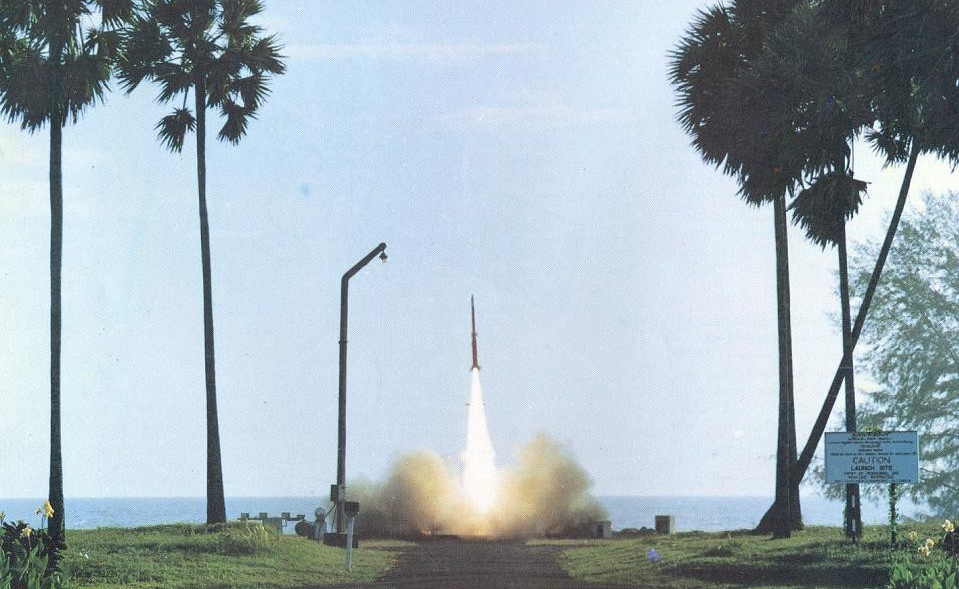
An upper-atmosphere experiment begins at the coastA sounding-rocket launch at the Thumba Equatorial Rocket Launching Station. Rocket-borne measurements formed part of the wider optical and upper-atmosphere research lineage.A. Jayaraman’s personal archive.View image ↗
Different platforms answer different questions. A rocket samples a brief ascent through the upper atmosphere; a balloon offers a slower passage and can carry scanning or tracking instruments. The useful comparison is the sampling geometry and measurement principle.
INDOEX connected Indian and international capabilities across ships, islands, aircraft and satellites. The Sagar Kanya papers belong to that shared investigation of aerosols over the tropical Indian Ocean.
The 2001 cruise paper by A. Jayaraman, S. K. Satheesh, A. P. Mitra and V. Ramanathan combined column and near-surface properties along the 1999 route. The earlier pre-INDOEX paper had its own campaign, observing period and author team. Keeping those contributions distinct makes the history more informative. Read the study ↗
Scientific collaboration is also visible in the methods. A transport interpretation needs meteorology; an energy estimate needs radiative transfer; an absorption measurement needs careful instrument correction. The scientific result depends on these linked skills as well as on the platform that carried the equipment.
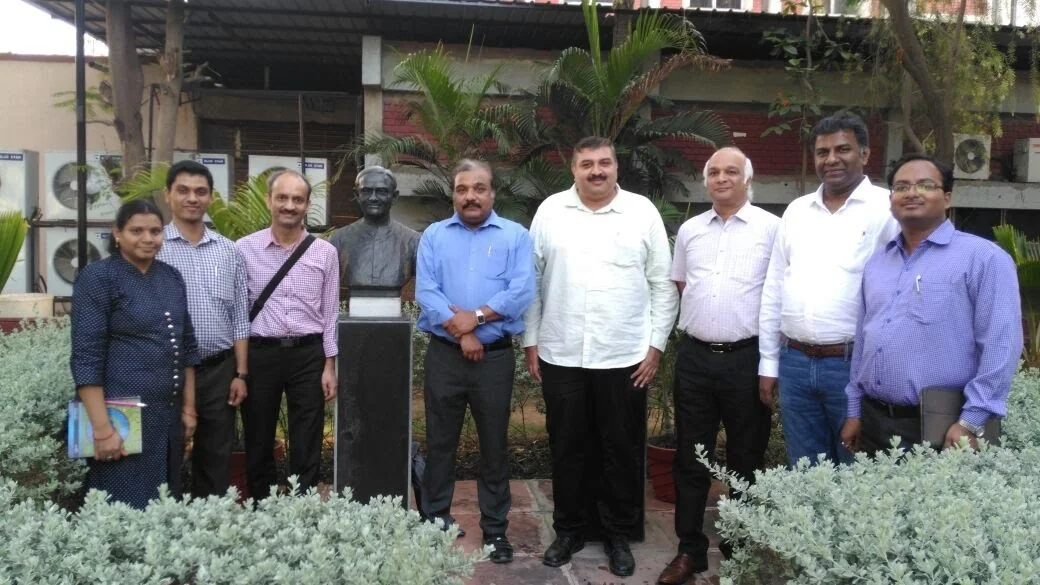
At PRL, the aerosol research team brought together work on instruments, observations and interpretation. A common question could require calibration, field measurements and a radiative-transfer calculation, with each contribution constraining a different part of the answer.
The aerosol research team at PRL, Ahmedabad, with A. Jayaraman in the blue shirt, beside a bust of PRL founder Vikram Sarabhai. A. Jayaraman’s personal archive.
The Hyderabad airborne study joined H. Gadhavi and A. Jayaraman around a practical instrument choice: point a compact lidar down from an aircraft. The Delhi fog investigation brought D. Ganguly, Jayaraman, T. A. Rajesh and Gadhavi into a campaign combining several optical and physical measurements.
The mobile road study added A. Misra and S. Ramachandran to a team measuring regional aerosol variability. These bylines identify distinct research contributions, rather than a single person’s expedition narrative. Read the study ↗Read the study ↗
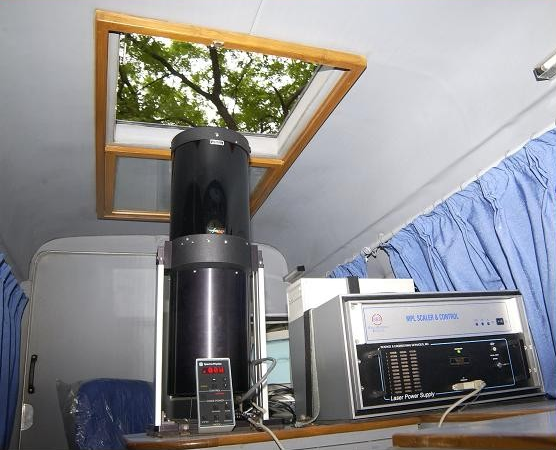
The mobile laboratory carried a compact lidar beneath an opening in the roof, with its power and acquisition systems alongside it. The arrangement gave the optical instrument a clear view upward while several complementary measurements travelled with it.
The instrument inside the travelling laboratoryThe micro-pulse lidar sits beneath a roof opening, with its power and acquisition electronics alongside it. The practical arrangement connects the instrument’s optical path to the field platform.A. Jayaraman’s personal archive.View image ↗
At Gadanki, NARL provides a setting for studying the atmosphere vertically and over long periods. Research there connects aerosols, cloud structure and atmospheric dynamics. A long record requires repeated observation, instrument maintenance, calibration and a record of when measurements were possible.
Pandit and colleagues’ sixteen-year cirrus study combined the Gadanki lidar with satellite observations. Gadhavi and Jayaraman’s absorption study used spectral measurements to examine a different part of the aerosol problem. The same location supported questions at very different heights and scales. Read the study ↗
BATAL extended the observing network through balloon measurements near the Asian monsoon tropopause. NARL, NASA Langley, TIFR, PRL and other collaborators contributed different instruments and operational capabilities. Its scientific strength came from the combination. Read the study ↗
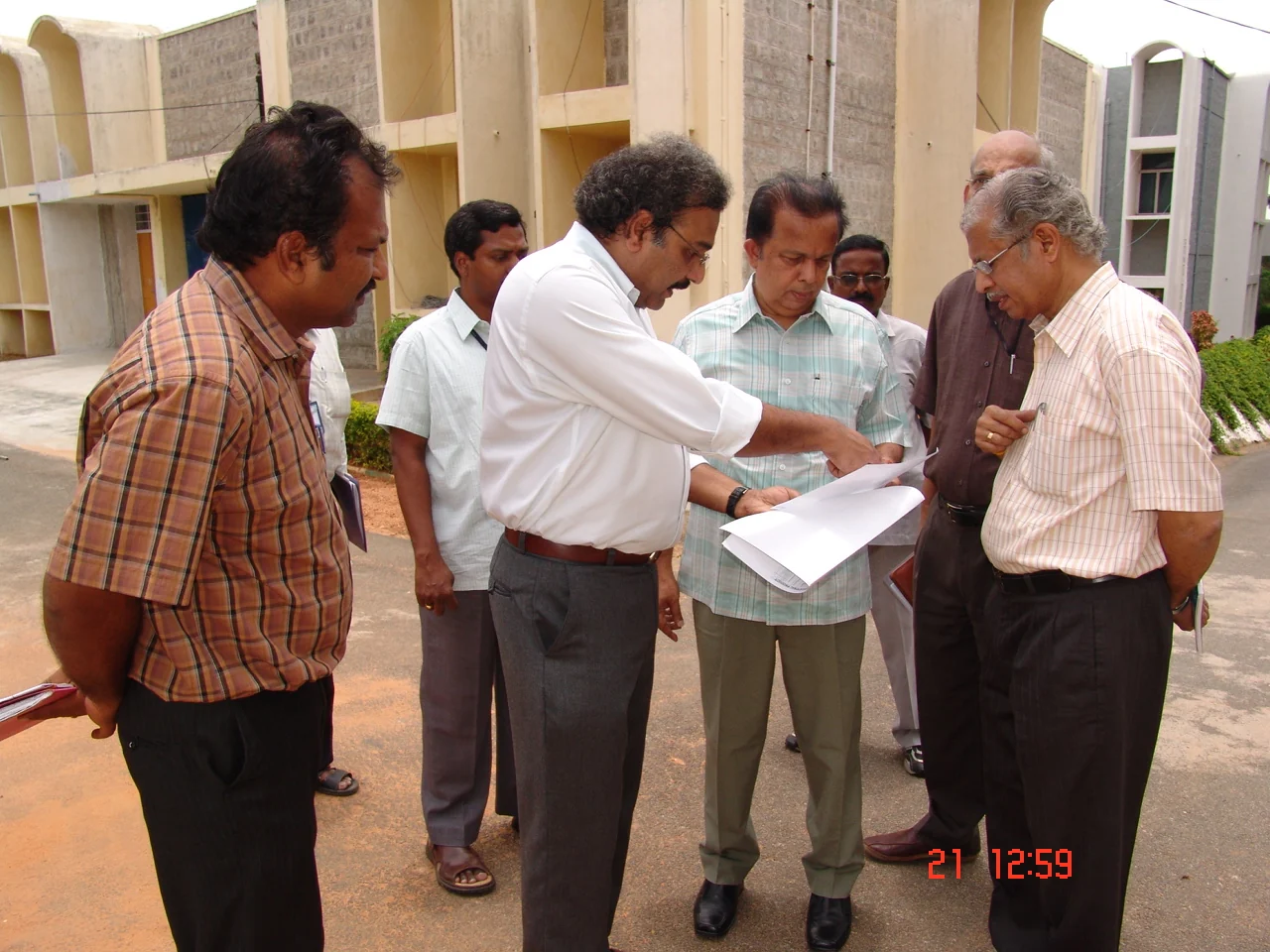
Planning for a continuing recordA. Jayaraman, then Director of NARL, explains plans for augmenting the laboratory to Madhavan Nair, then Chairman of ISRO. Sustained observation depends on the facilities and technical capabilities developed around each experiment.A. Jayaraman’s personal archive.View image ↗
A measurement lasts as scientific evidence when others can understand what was observed and test the interpretation. Papers preserve methods and findings; instrument records explain the response; photographs recover the setting in which work took place.
A. Jayaraman’s 2023 retrospective follows several of these episodes through the questions, instruments and collaborations that shaped them. Photometry, lidar and field sampling each made a different atmospheric property accessible, while their combination made the interpretations more testable.
The continuing question is not only what researchers found. It is how they made a previously invisible part of the atmosphere accessible to measurement—and how the next observation might test what they inferred.